4.9 · 464 Google reviews · Licensed & Insured
Happy’s › Services › Hazardous & Storm-Damaged Tree Removal
Hazardous & Storm-Damaged Tree Removal
Leaning, split, uprooted or hollow - hazardous tree removal with crane support, assessed by an ISA Certified Arborist. Call (727) 365-1803.
“Steven was great, him and his crew got out early and was here all day taking out my four laurel oaks for me. Start to finish it was a pleasure working with happy tree service. The speed and efficiency of the work was fantastic.”
- 464 Google reviews
- Licensed & Insured
- ISA Certified Arborist on staff
- Pinellas since 1989
A hazardous tree isn’t the same thing as an inconvenient one. It’s a specific, assessable condition, a real structural defect that puts a real target (your roof, your driveway, the neighbor’s fence, a person) within range if the tree or a major part of it comes down. Telling the difference between "hazardous" and "just needs attention" is the actual job here, and it’s why Happy’s Tree Service keeps an ISA Certified Arborist on staff instead of sending a crew out to eyeball it and guess.
We’ve been doing this in Pinellas County since 1989. In sandy coastal soil, under a canopy that’s mostly live oak, laurel oak, and sabal palm, and through 37 hurricane seasons, we’ve seen what actually fails and what just looks like it might. That distinction matters for your safety, and it matters for your wallet, because under current Pinellas County rules, removing a tree you didn’t need to remove isn’t a shrug-and-move-on mistake. It can carry a real penalty, and the liability for an unauthorized removal follows the property, not just whoever swung the saw. We’ll cover that below, because it’s the part most tree companies don’t explain and homeowners find out about the hard way.
What actually makes a tree hazardous
An arborist doesn’t call a tree hazardous because it’s tall, old, or dropping limbs occasionally, every tree does that. We’re looking for specific, documentable defects:
Root plate movement or soil heaving
at the base, especially after heavy rain or wind, a sign the root system is already losing its grip in Pinellas' sandy soil.
Cavities and decay
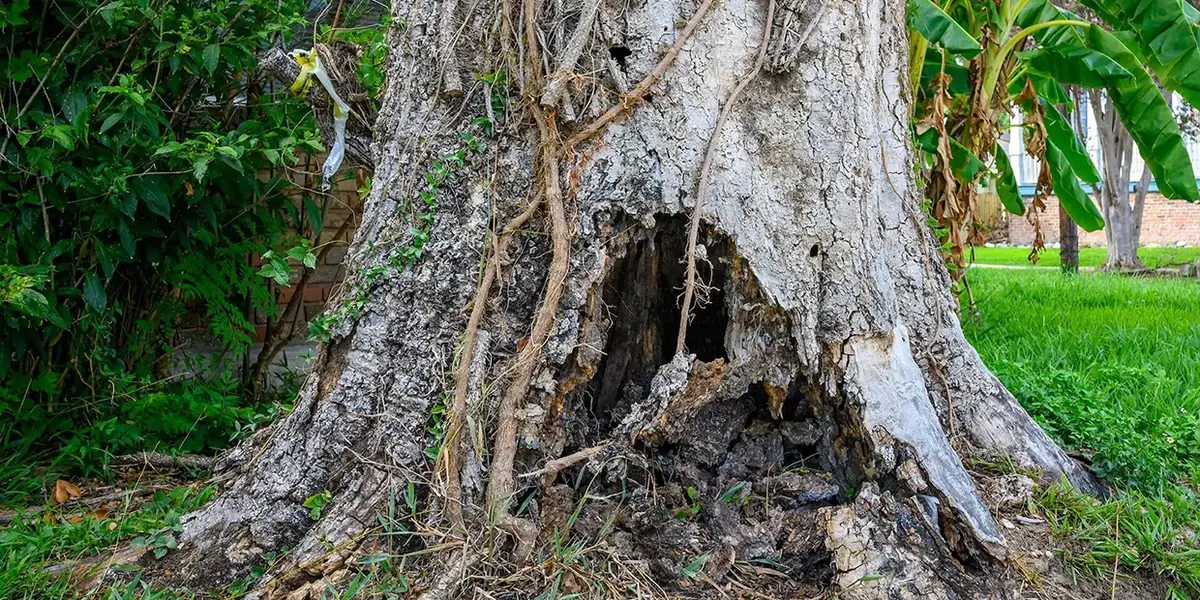
in the trunk or major scaffold limbs, particularly where they’re large enough to compromise the wood’s remaining structural section.
Included bark
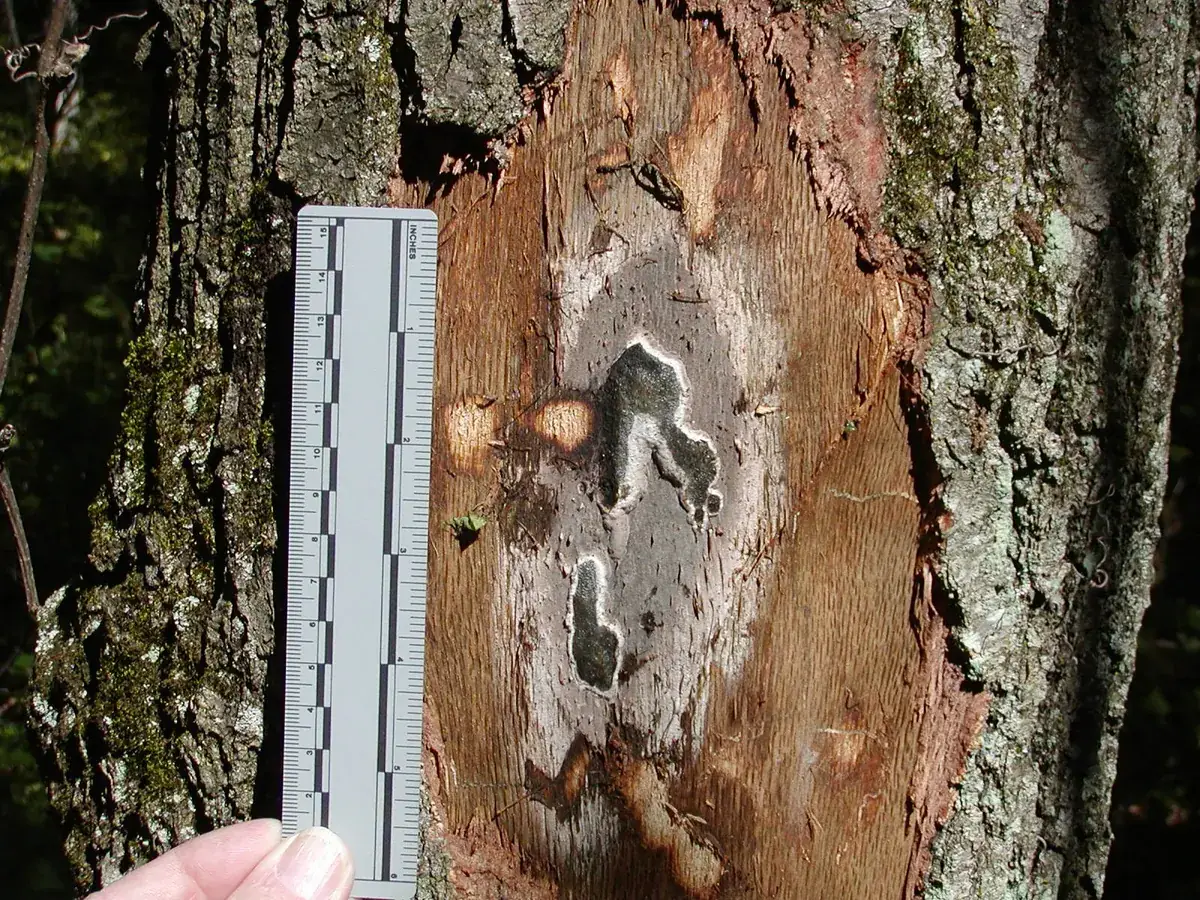
at a major branch union, where two big limbs grow so tightly together that bark gets pinched between them instead of solid wood, which is a classic failure point in live oaks and laurel oaks as they age.
Dead or dying scaffold limbs
over a target, a roof, a driveway, a play area, versus dead wood over open space, which is a much lower priority.
Prior storm damage
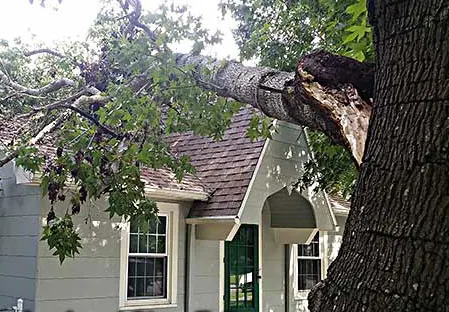
that was never corrected, a codominant stem that split and was left, a crown that was topped (more on why that’s its own problem below), or root damage from a past flood or construction.
Lean, especially sudden or recent lean
versus a tree that has always grown at an angle and is compensating for it structurally.
A real assessment weighs the defect against the target, the site, and the species. A dead laurel oak over an empty side yard and the same dead laurel oak over a bedroom are two different risk levels, even though the tree itself is identical.
Why the permit picture matters here, and where 163.045 comes in
In unincorporated Pinellas County, most trees on a residential lot are "protected" under the county’s tree ordinance, and removing a protected tree without an approved permit carries a real financial penalty, even if the tree was dead or storm-damaged, because the current county code doesn’t carve out an automatic exception for either. (Full detail, thresholds, and the county’s own permitting process are on our Pinellas County tree permit page.)
There is one path around that: Florida Statute § 163.045. It lets a single-family homeowner remove a genuinely hazardous tree without a local permit, fee, or replanting requirement, but only with a signed, on-site risk assessment from an ISA Certified Arborist, documenting that removal is the only practical way to bring the tree’s risk down to an acceptable level. It doesn’t apply to rental property, vacant lots, commercial or multifamily sites, mangroves, or trees in the public right-of-way, and it doesn’t mean "no city or county involvement ever", it means the five specific requirements (notice, application, approval, permit, fee, and mitigation) are off the table for that one qualifying removal.
We have that arborist on staff. Part of what we do on a hazard call is figure out, honestly, whether your situation actually qualifies for that path, and if it doesn’t, we tell you what permit route it does need instead of quietly skipping the paperwork.
Start here
Send us a photo of the tree.
You do not have to know whether it needs to come down. That is the part we are for.
- One photo, whole tree in frameTrunk base to top. A close-up of anything that looks wrong helps.
- Text us the photoThe text button below opens the right thread. Add your street and city.
- We come out and lookEvery estimate is in person, free, sometimes the answer is that it needs nothing.
How we actually do it
Every hazardous removal starts with the arborist on-site, not a sales visit. We look at the defect, the target, the access, and the surrounding trees before anyone talks about equipment or scheduling. From there:
- Assessment and documentation. If the situation may qualify for the 163.045 path, or simply needs to support a standard county permit application, the write-up happens before the saw does.
- Equipment plan. Man lifts, grapple trucks and a crane on the technical picks: which of them the tree needs is settled before the saw starts, not on the day. A tree over a pool cage gets craned out in sections and set down clear of the enclosure. A tree with open drop room gets felled conventionally. A tall interior tree with no lay-down room gets climbed and rigged down piece by piece, or lifted out with the man lift, depending on access.
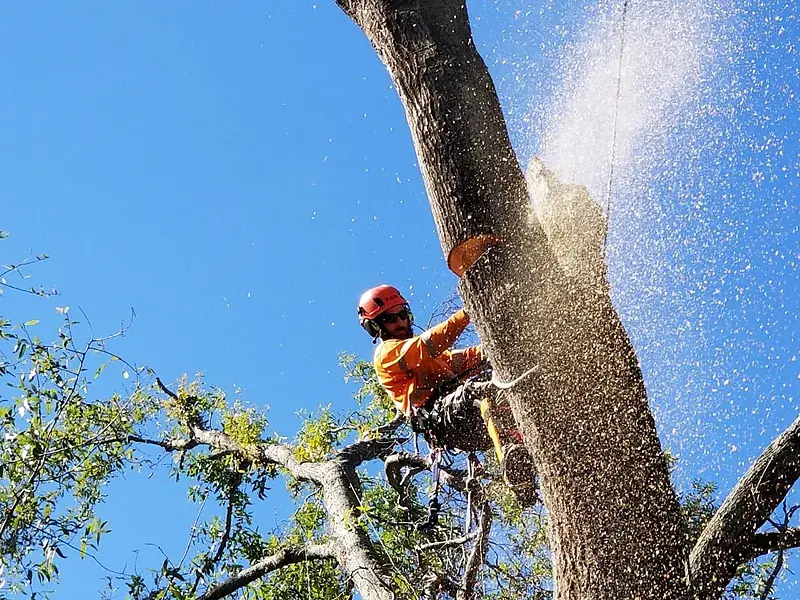
- The removal itself, worked top-down in controlled sections wherever there’s a target nearby, never one uncontrolled drop toward a house, a fence line, or a neighbor’s yard.
- Cleanup. Wood sectioned and hauled or chipped, the site cleared. Stump removal is separate, see our stump removal page, but we’ll quote both at the same visit.
Call for current lead time, the owner runs the schedule personally.
If a tree is actively failing right now, don’t wait for a scheduled appointment, call and say so. See our emergency tree service and storm damage cleanup pages for that situation specifically. For a tree that’s concerning but not actively falling, our tree risk assessment service is the right starting point.
Frequently Asked Questions
Is my tree actually a hazard, or does it just look bad? Not every leaning, thinning, or oddly-shaped tree is hazardous, and we’ll tell you honestly when one isn’t. A hazard assessment looks at specific, documentable defects, root plate movement, cavities, dead scaffold limbs, included bark at a major union, girdling roots, prior storm damage, weighed against what the tree could hit if it failed. Plenty of ugly trees are structurally sound. Some good-looking trees aren’t.
Do I need a permit to remove a hazardous tree in Pinellas County? Usually yes. Under the county’s tree code (Pinellas County Code Ch. 58, Art. XIX, effective January 23, 2026), most trees on a residential lot are "protected" and need an approved permit to remove, even a dead or storm-damaged one. There is one statewide exception for qualifying single-family homes, covered above and in full on our Pinellas County tree permit page.
What is Florida Statute 163.045 and does it apply to me? It’s a state law that lets a local government’s permit requirement be set aside for one specific situation: a single-family, owner-occupied residential property, where an ISA Certified Arborist (or Florida licensed landscape architect) has done an on-site assessment and documented that the tree’s risk can’t practically be brought down to an acceptable level any way short of removal. It doesn’t apply to rentals, vacant lots, multifamily or commercial property, mangroves, or right-of-way trees. We’ll tell you plainly if your property qualifies.
Can you remove the tree the same day you assess it? Sometimes, if the crew and equipment for the job are already scheduled that day and the assessment confirms it’s genuinely urgent. Most hazardous removals are scheduled within a few days once we know the access, the equipment needed, and whether documentation has to be prepared first. For an active emergency, a tree already down or failing right now, see our emergency tree service page.
What happens to the wood and debris? Standard hazardous removals include full cleanup, the trunk sectioned down, limbs chipped or hauled, and the site left clear. Stump removal is a separate line item; see our stump removal page.
We assess and remove hazardous trees throughout Clearwater and across Pinellas County, including Largo and St. Petersburg.
Next step
Call (727) 365-1803 or request a free estimate and we’ll get an ISA Certified Arborist’s eyes on the tree, honestly, before anyone talks about removal.
Google reviews
Rated 4.9 by 464 of your neighbors.
Reviews · Hazardous & Storm-Damaged Tree Removal
4.9
464 reviews on Google, the count on our public Google listing
“Happy trees did an amazing job cutting my trees and providing information. Steve was really nice and knowledgeable. Great communication and pricing. Definitely will be using their service again!!”
“Fast quote and when we decided it was time to remove our Oak, they were there on time and ready to get to work. They have all the equipment necessary for this huge job and work very efficiently.”
Every one of these lives on our public Google listing, where we cannot edit or delete a word. Read them all on Google →
Frequently asked
Questions we get asked on this one.
Is my tree actually a hazard, or does it just look bad?
Not every leaning, thinning, or oddly-shaped tree is hazardous, and we’ll tell you honestly when one isn’t. A hazard assessment looks at specific, documentable defects, root plate movement, cavities, dead scaffold limbs, included bark at a major union, girdling roots, prior storm damage, weighed against what the tree could hit if it failed. Plenty of ugly trees are structurally sound. Some good-looking trees aren’t.
Do I need a permit to remove a hazardous tree in Pinellas County?
Usually yes. Under the county’s tree code (Pinellas County Code Ch. 58, Art. XIX, effective January 23, 2026), most trees on a residential lot are "protected" and need an approved permit to remove, even a dead or storm-damaged one. There is one statewide exception for qualifying single-family homes, covered below and in full on our Pinellas County tree permit page.
What is Florida Statute 163.045 and does it apply to me?
It’s a state law that lets a local government’s permit requirement be set aside for one specific situation: a single-family, owner-occupied residential property, where an ISA Certified Arborist (or Florida licensed landscape architect) has done an on-site assessment and documented that the tree’s risk can’t practically be brought down to an acceptable level any way short of removal. It doesn’t apply to rentals, vacant lots, multifamily or commercial property, mangroves, or right-of-way trees. We’ll tell you plainly if your property qualifies.
Can you remove the tree the same day you assess it?
Sometimes, if the crew and equipment for the job are already scheduled that day and the assessment confirms it’s genuinely urgent. Most hazardous removals are scheduled within a few days once we know the access, the equipment needed, and whether documentation has to be prepared first. For an active emergency, a tree already down or failing right now, see our emergency tree service page.
What happens to the wood and debris?
Standard hazardous removals include full cleanup, the trunk sectioned down, limbs chipped or hauled, and the site left clear. Stump removal is a separate line item; see our stump removal page.
Related