4.9 · 464 Google reviews · Licensed & Insured
Happy’s › Services › Land Clearing & Lot Clearing in Pinellas County
Land Clearing & Lot Clearing in Pinellas County
Lot clearing for builders and owners - selective clearing, invasive removal, stumps and haul-off, protected trees identified first. (727) 365-1803.
“This was the second time I'd hired Happy's to take down some dead trees and I couldn't be happier with the job they did. First off they gave me a great price for the amount of work I needed done.”
- 464 Google reviews
- Licensed & Insured
- ISA Certified Arborist on staff
- Pinellas since 1989
Land clearing is different from removing a single tree, mostly because of what it does to the permit math. A single hazardous oak is one tree, one decision. Clearing a lot for a new build, an addition, or a major landscaping project usually means multiple protected trees at once, and in Pinellas County that means the permit question has to be answered correctly before the first tree comes down, not worked out afterward.
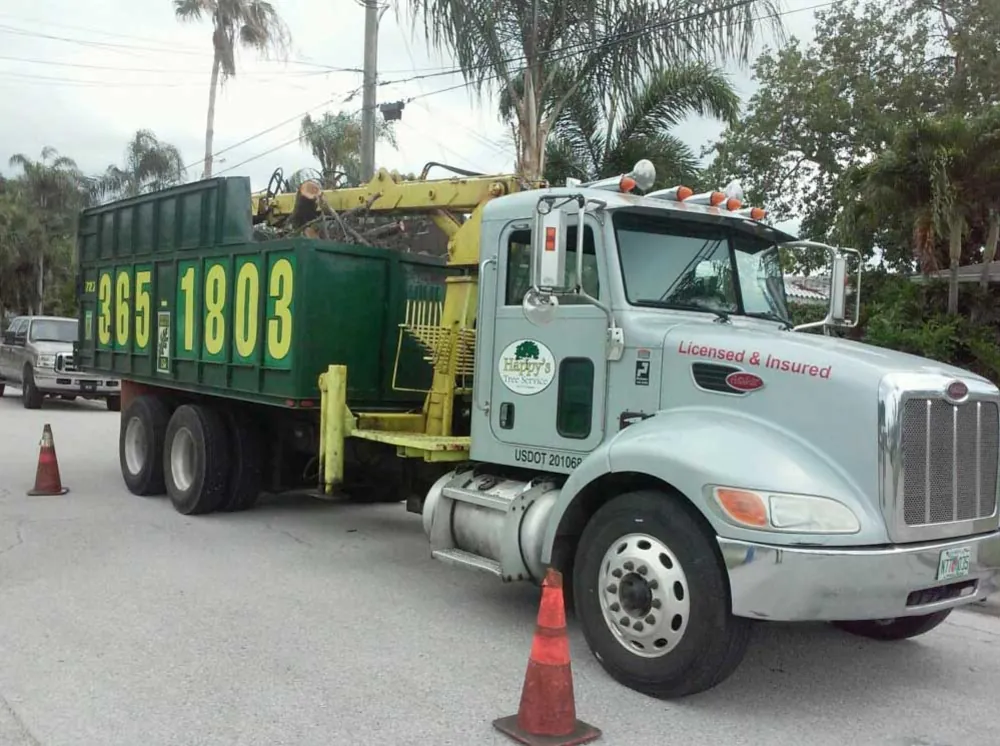
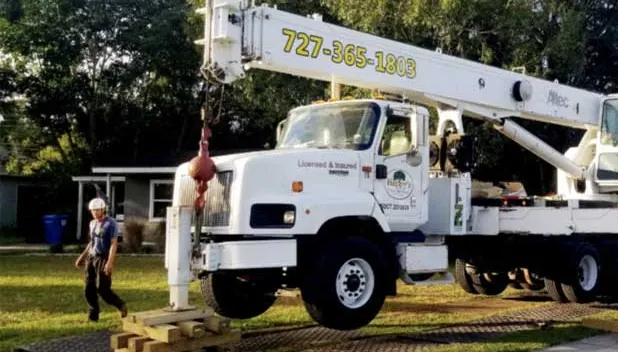
Happy’s has been clearing land across Pinellas County since 1989, as a family business, matching the machine to the site: grapple trucks for volume, a crane for tight or obstructed sites, man lifts for tall trees needing controlled section work. Getting that right matters more on a clearing job than almost any other service we offer, because clearing several trees off a lot is as much a logistics and equipment problem as a cutting problem.
Get the permit question right first
Under the county’s current tree ordinance, most trees on a lot count as "protected" and need an approved permit to remove, generally, any tree 4 inches or more in trunk diameter (measured 4.5 feet up the trunk) or any palm 6 feet or taller. If the property is a homesteaded, owner-occupied single- family home, that threshold changes: only trees larger than 24 inches in trunk diameter are protected under that specific carve-out. Those are two very different pictures of what a "clearing" project legally involves, and getting the wrong one applied to your property is how a clearing job turns into a violation.
The county’s code doesn’t have a blanket exception for dead, declining, or storm-damaged trees either, even a dead tree on a residential lot generally still needs a permit to remove, though its condition can reduce or eliminate the replanting requirement. The one real exception is Florida Statute § 163.045, and it’s narrow: it applies to individual hazardous trees on qualifying single-family homes, documented by an ISA Certified Arborist, not to a general clearing project. See our hazardous tree removal page if that’s closer to your actual situation.
Removing protected trees without the required permit carries a real cost, under the current code, a penalty of $150 per inch of trunk diameter for each unauthorized tree, on top of whatever replanting is owed, and that liability isn’t limited to the property owner. We handle the permit application as part of a clearing project specifically because getting this wrong on a multi-tree job is expensive in a way it usually isn’t on a single removal. Full rules are on our tree permit page.
How we actually do it
- Site survey. We walk the lot, identify every tree that’s protected under the county’s rules, and mark which are coming out and which are staying, including any species with special handling considerations, like sabal palms or established live oaks worth preserving where they don’t conflict with the project.
- Permit application, using the survey as the basis for the county’s process, which asks for tree location, species, and diameter as part of a complete application.
- Protection of trees staying on site, barricading root zones on trees marked to remain, so equipment traffic and log-hauling don’t damage what you’re keeping.
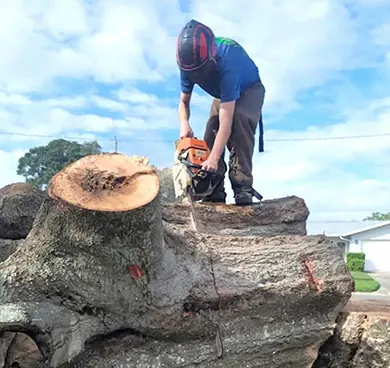
- Clearing itself, sequenced by equipment: crane or man lift work on any tree needing controlled sectioning first, conventional felling where there’s open room, and grapple trucks moving logs and brush continuously rather than waiting until the end.
- Debris hauling and site cleanup, plus stump removal if the project calls for it, see our stump removal page, and replanting, if the permit requires it, coordinated with your landscaper or handled directly.
A multi-tree clearing job does not have to be staged around one crew doing everything in sequence: we can run removal, hauling, and stump work in parallel where the site allows it.
Start here
Send us a photo of the tree.
You do not have to know whether it needs to come down. That is the part we are for.
- One photo, whole tree in frameTrunk base to top. A close-up of anything that looks wrong helps.
- Text us the photoThe text button below opens the right thread. Add your street and city.
- We come out and lookEvery estimate is in person, free, sometimes the answer is that it needs nothing.
Frequently Asked Questions
Does land clearing need a permit in Pinellas County? Almost always, yes, and clearing usually involves more than one protected tree, so it’s worth getting the permit question right before any equipment moves. Under the county’s tree code, a "protected tree" is generally any tree 4 inches or more in trunk diameter (measured at 4.5 feet up) or any palm 6 feet or taller; on a homesteaded, owner-occupied single-family lot, that threshold is different, only trees larger than 24 inches in trunk diameter count as protected. Full detail is on our tree permit page.
What happens if trees are cleared without a permit? Under the current county code, unauthorized removal of a protected tree carries a penalty of $150 per inch of trunk diameter, on top of any required replacement trees, and that liability can attach to whoever did the clearing as well as the property owner, and it doesn’t go away when the property changes hands. This is exactly the situation we plan around before starting a clearing job, not after.
Do I have to replant after clearing? Often, yes, and the number of replacement trees required depends on the size and condition rating of what’s removed, not a flat count per lot. We’ll go over the replanting obligation for your specific project as part of the estimate, and can talk through options on our tree replacement page.
Can you clear land that still has some trees we want to keep? Yes, selective clearing, working around trees marked to stay, is most of what we do. We tag and protect the trees you’re keeping before equipment moves, and the surrounding trees left standing get factored into equipment placement and drop zones.
What equipment do you use for larger clearing jobs? Whatever the site actually calls for: grapple trucks for high-volume log and brush handling, a crane for trees with no safe drop zone, and man lifts for tall trees needing to come down in controlled sections. See the crane-assisted removal page for how that piece works.
We clear land in Clearwater, Largo, and throughout Pinellas County.
Next step
Call (727) 365-1803 or request a free estimate and we’ll survey the lot, sort out the permit picture, and give you a real plan before anything is cut.
Google reviews
Rated 4.9 by 464 of your neighbors.
Reviews · Land Clearing & Lot Clearing in Pinellas County
4.9
464 reviews on Google, the count on our public Google listing
“Steven was great, him and his crew got out early and was here all day taking out my four laurel oaks for me. Start to finish it was a pleasure working with happy tree service. The speed and efficiency of the work was fantastic.”
“This was the second time I'd hired Happy's to take down some dead trees and I couldn't be happier with the job they did. First off they gave me a great price for the amount of work I needed done.”
Every one of these lives on our public Google listing, where we cannot edit or delete a word. Read them all on Google →
Frequently asked
Questions we get asked on this one.
Does land clearing need a permit in Pinellas County?
Almost always, yes, and clearing usually involves more than one protected tree, so it’s worth getting the permit question right before any equipment moves. Under the county’s tree code, a "protected tree" is generally any tree 4 inches or more in trunk diameter (measured at 4.5 feet up) or any palm 6 feet or taller; on a homesteaded, owner- occupied single-family lot, that threshold is different, only trees larger than 24 inches in trunk diameter count as protected. Full detail is on our tree permit page.
What happens if trees are cleared without a permit?
Under the current county code, unauthorized removal of a protected tree carries a penalty of $150 per inch of trunk diameter, on top of any required replacement trees, and that liability can attach to whoever did the clearing as well as the property owner, and it doesn’t go away when the property changes hands. This is exactly the situation we plan around before starting a clearing job, not after.
Do I have to replant after clearing?
Often, yes, and the number of replacement trees required depends on the size and condition rating of what’s removed, not a flat count per lot. We’ll go over the replanting obligation for your specific project as part of the estimate, and can talk through options on our tree replacement page.
Can you clear land that still has some trees we want to keep?
Yes, selective clearing, working around trees marked to stay, is most of what we do. We tag and protect the trees you’re keeping before equipment moves, and the surrounding trees left standing get factored into equipment placement and drop zones.
What equipment do you use for larger clearing jobs?
Whatever the site actually calls for: grapple trucks for high-volume log and brush handling, a crane for trees with no safe drop zone, and man lifts for tall trees needing to come down in controlled sections. See the crane-assisted removal page for how that piece works.