4.9 · 464 Google reviews · Licensed & Insured
Happy’s › Services › Crane-Assisted Tree Removal
Crane-Assisted Tree Removal
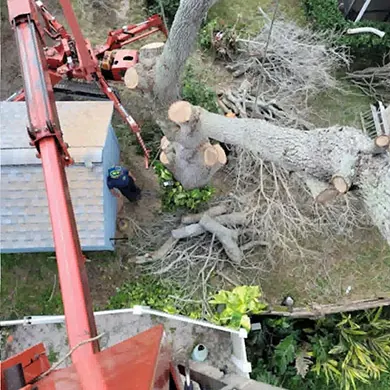
Trees over roofs, pools and seawalls come out by crane, not by luck. A crane on the technical picks, man lifts for the rest. (727) 365-1803.
“Fast quote and when we decided it was time to remove our Oak, they were there on time and ready to get to work. They have all the equipment necessary for this huge job and work very efficiently.”
- 464 Google reviews
- Licensed & Insured
- ISA Certified Arborist on staff
- Pinellas since 1989
Most trees don’t need a crane. Most trees have somewhere to fall, or can be sectioned down safely by a climber with rigging. A crane comes into the picture for the tree that doesn’t have either option, the one wedged between two houses, leaning over a pool cage, or standing in a backyard with a fence line, a shed, and a neighbor’s property all within the drop radius. That’s a small share of the removals we do, but it’s the share other companies often turn down, because a crane job needs a machine, an operator and a plan that most tree services cannot put on a residential lot.
Happy’s uses a crane on the technical picks. That single fact changes what jobs we can say yes to, and it’s the reason we’re writing a whole page about a removal method instead of folding it into a general tree removal page.
What actually calls for a crane
We recommend crane-assisted removal specifically when at least one of these is true:
There’s no safe drop zone
the tree is boxed in by structures, fence lines, or property boundaries on every side.
Rope-rigging alone can’t control the weight safely
a large-diameter section, especially in a heavy hardwood like a mature live oak, can be more than a climber can safely lower by hand-rigging, even with a block-and-tackle system.
The tree stands over something that can’t tolerate impact
a pool cage, a screened lanai, a paver patio, a car that can’t be moved, a roof with limited setback.
Access is too tight for a grapple truck or bucket lift to work the tree conventionally
but there’s a clear enough approach for the crane and its outriggers.
If a tree doesn’t need this, if it has open ground to fall into, or can be safely sectioned down by rope, we’ll say so. The crane adds time and cost, and we’re not going to bring one in for a job that doesn’t call for it.
How we actually do it
- Site walk and rigging plan. The arborist and crane operator look at the tree, the crane’s placement options, ground load (relevant on soft, sandy Pinellas lots, crane pads or mats get used where the ground can’t take the outrigger load directly), and the overhead and underground obstacles between the crane and the tree.
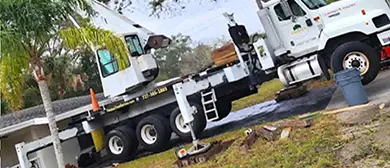
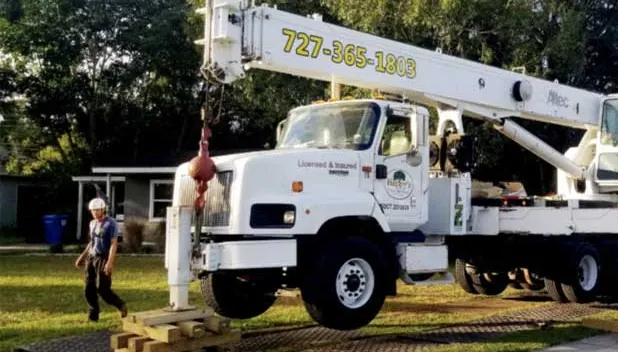
- Placement. The crane sets up where it can reach the tree without its own boom or load path crossing power lines, and where the outriggers land on stable ground, sometimes that means the street, sometimes the driveway, sometimes a specific spot in the yard we’ll confirm with you in advance.
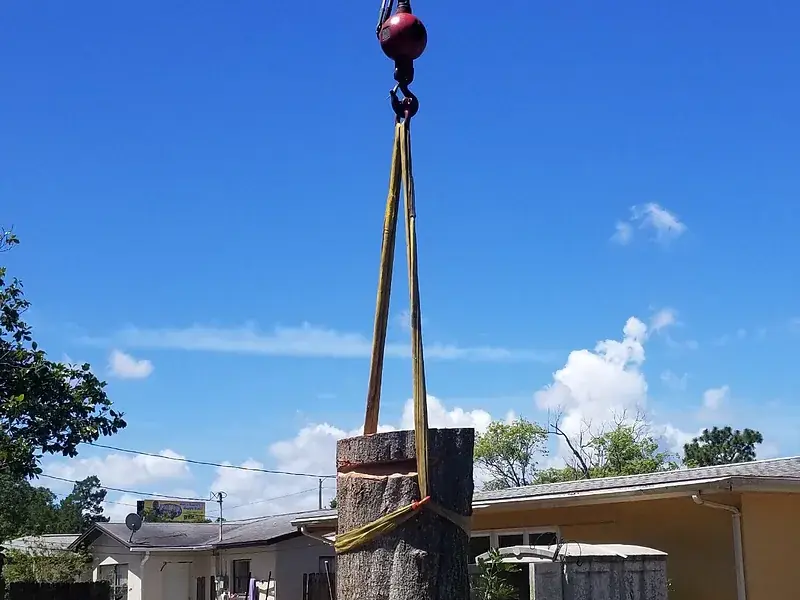
- The lift. A climber (or the man lift, depending on the tree) rigs each section to the crane’s line before it’s cut free, so the piece is fully supported the moment it separates from the tree, nothing is ever dropped and caught. Sections come down in a controlled path directly to a clear landing zone, then get bucked up and loaded.
- Grapple truck cleanup. Once sections are on the ground, a grapple truck loads logs and brush fast, which matters on a job where the crane’s time on-site is the most expensive part of the day.
- Site restoration. Rigging points, crane pad materials, and any ground protection come out last, and the site gets walked before we leave.
Crane day is planned like any other day of work: one crew, one plan, the pick sequenced before anyone starts the saw. Man lifts and grapple trucks work the rest of the job, the debris leaves the same day, and the number you were quoted is the number.
Start here
Send us a photo of the tree.
You do not have to know whether it needs to come down. That is the part we are for.
- One photo, whole tree in frameTrunk base to top. A close-up of anything that looks wrong helps.
- Text us the photoThe text button below opens the right thread. Add your street and city.
- We come out and lookEvery estimate is in person, free, sometimes the answer is that it needs nothing.
Where this connects
Crane-assisted work shows up most often on hazardous tree removal jobs where a defective tree stands over something that can’t take an uncontrolled failure, on multi-tree land clearing projects with tight lot access, and after major wind events on our storm damage cleanup calls, when a tree has already come to rest against a structure and has to be lifted off rather than cut free and dropped further onto it.
Frequently Asked Questions
When does a tree actually need a crane instead of a standard removal? When there’s no safe way to get the tree down otherwise, over a pool cage or screened enclosure, wedged tight between two houses, leaning toward a structure with no room to rig a controlled rope-lowered section, or too large and heavy to safely lower by hand-rigging alone. If a tree can be felled into open ground or sectioned down by rope, we’ll usually recommend that instead, the crane is for jobs that genuinely need it, not every job.
Is the crane part of your regular operation? Yes. A crane pick is a standard part of how the technical trees come down, and man lifts and grapple trucks handle the rest of the job. The same crew plans the pick, does the cutting, and hauls the debris away.
Will a crane damage my lawn, driveway, or pool cage? We plan crane placement and rigging paths specifically to avoid the structures you’re trying to protect, that’s usually the entire reason a crane job was called for in the first place. We’ll walk the placement and access plan with you before the day of the job.
How long does a crane-assisted removal take? Setup, rigging, and the lift itself typically take longer than a conventional felling, because every section is controlled rather than dropped. Exact time depends on the tree’s size, the number of lifts needed, and site access, we’ll give you a realistic estimate for your specific tree.
Does a crane removal still need a permit? The removal method doesn’t change the permit question, that depends on the tree and the property, not on how it comes down. See our tree permit page for Pinellas County’s current rules.
Crane jobs run throughout Clearwater and St. Petersburg, and the rest of Pinellas County.
Next step
Call (727) 365-1803 or request a free estimate, we’ll tell you honestly whether your tree actually needs a crane, or whether a standard removal will do the job.
Google reviews
Rated 4.9 by 464 of your neighbors.
Reviews · Crane-Assisted Tree Removal
4.9
464 reviews on Google, the count on our public Google listing
“Steven was great, him and his crew got out early and was here all day taking out my four laurel oaks for me. Start to finish it was a pleasure working with happy tree service. The speed and efficiency of the work was fantastic.”
“This was the second time I'd hired Happy's to take down some dead trees and I couldn't be happier with the job they did. First off they gave me a great price for the amount of work I needed done.”
Every one of these lives on our public Google listing, where we cannot edit or delete a word. Read them all on Google →
Frequently asked
Questions we get asked on this one.
When does a tree actually need a crane instead of a standard removal?
When there’s no safe way to get the tree down otherwise, over a pool cage or screened enclosure, wedged tight between two houses, leaning toward a structure with no room to rig a controlled rope-lowered section, or too large and heavy to safely lower by hand-rigging alone. If a tree can be felled into open ground or sectioned down by rope, we’ll usually recommend that instead, the crane is for jobs that genuinely need it, not every job.
Is the crane part of your regular operation?
Yes. A crane pick is a standard part of how the technical trees come down, and man lifts and grapple trucks handle the rest of the job. The same crew plans the pick, does the cutting, and hauls the debris away.
Will a crane damage my lawn, driveway, or pool cage?
We plan crane placement and rigging paths specifically to avoid the structures you’re trying to protect, that’s usually the entire reason a crane job was called for in the first place. We’ll walk the placement and access plan with you before the day of the job.
How long does a crane-assisted removal take?
Setup, rigging, and the lift itself typically take longer than a conventional felling, because every section is controlled rather than dropped. Exact time depends on the tree’s size, the number of lifts needed, and site access, we’ll give you a realistic estimate for your specific tree.
Does a crane removal still need a permit?
The removal method doesn’t change the permit question, that depends on the tree and the property, not on how it comes down. See our tree permit page for Pinellas County’s current rules.