
4.9 · 464 Google reviews · Licensed & Insured
Happy’s › Services › Stump Grinding & Stump Removal
Stump Grinding & Stump Removal
Stumps ground below grade with the roots chased out, grindings hauled or backfilled, ready to replant or sod. Same-visit with removal. (727) 365-1803.
“Happy trees did an amazing job cutting my trees and providing information. Steve was really nice and knowledgeable. Great communication and pricing. Definitely will be using their service again!!”
- 464 Google reviews
- Licensed & Insured
- ISA Certified Arborist on staff
- Pinellas since 1989
A stump left in the ground after a tree comes down isn’t just an eyesore, in Pinellas' sandy soil, it can shift underfoot, attract termites and other wood-boring insects that then move toward the house, and sit right where you were planning to plant, pave, or build next. Happy’s Tree Service grinds and removes stumps across Pinellas County as its own service, whether we took the tree down ourselves or someone else did.
Grinding vs. full removal, and why it matters what you pick
These solve different problems, and the wrong choice for your situation means redoing the work later.
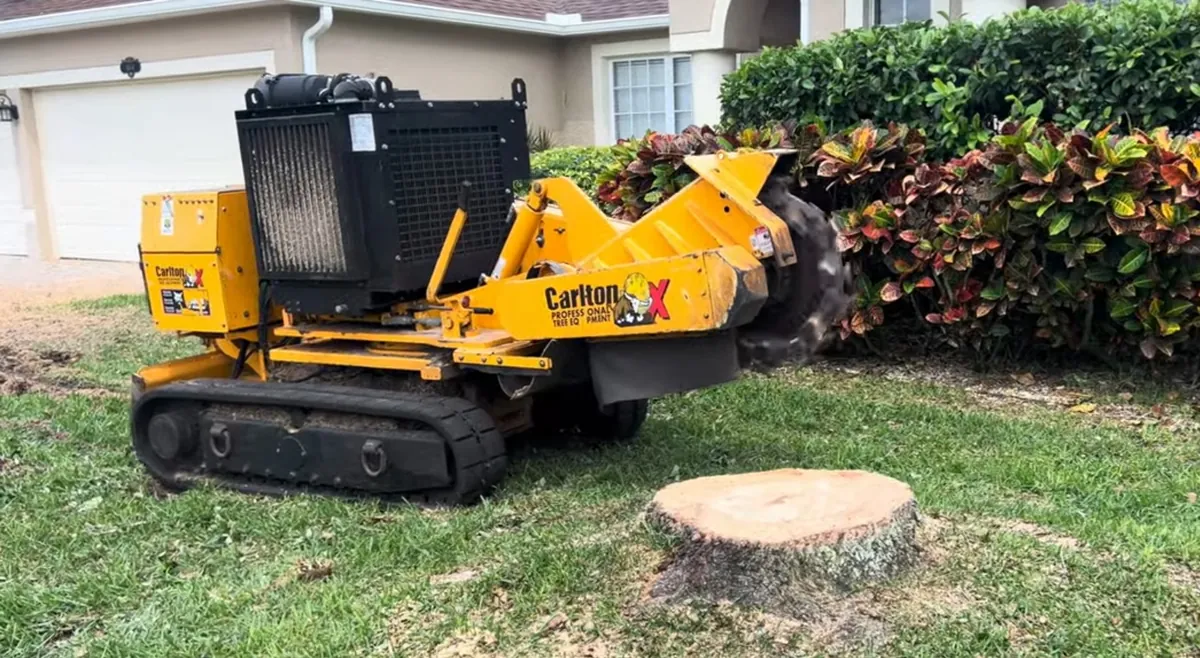
Stump grinding uses a grinding wheel to chew the stump and its upper root flare down below the surface. It’s faster, less invasive to surrounding lawn and landscaping, and leaves loose wood chips and soil you can rake, backfill, and reseed over. This is the right call for the large majority of residential jobs, you want the visible stump gone and the spot usable for grass or light landscaping, without tearing up a bigger area of yard to get there.
Full stump removal pulls the stump and its major root structure out of the ground entirely, leaving an open hole that has to be backfilled. It’s more disruptive and more expensive, and it’s the right call specifically when something with its own root system or foundation is going in that exact spot, a new tree planted in the same footprint, a paver patio, a shed foundation, or any hardscape that can’t tolerate old root material and decomposing wood underneath it.
Tell us what’s planned for the space and we’ll recommend the one that actually fits, rather than defaulting to whichever is faster to sell.
What Pinellas' sandy soil and species mix mean for the job
Local soil conditions and tree species both affect how a stump behaves:
Sandy soil drains fast
which means ground stump material and wood chips settle and decompose differently than they would in denser clay, expect some settling over the following season, and plan backfill accordingly.
Palm stumps
grind and decompose differently from hardwood stumps, palm tissue is fibrous rather than woody, and a ground sabal palm stump breaks down faster than an oak stump of similar size.
Live oak and laurel oak root systems
can extend well beyond the visible stump, especially on a mature tree. Grinding the visible stump removes the trip hazard and the regrowth point, but distant root sections can occasionally still send up minor suckering, worth knowing if you’re seeing sprouts several feet from where the tree stood.
Nearby underground utilities, septic lines, and irrigation
need to be flagged before grinding starts, particularly on older Pinellas County properties where utility placement isn’t always where current code would put it.
Start here
Send us a photo of the stump.
You do not have to know whether it needs to come down. That is the part we are for.
- One photo, whole stump in frameThe stump and the ground around it. A close-up of the trunk base helps.
- Text us the photoThe text button below opens the right thread. Add your street and city.
- We come out and lookEvery estimate is in person, free, sometimes the answer is that it needs nothing.
How we actually do it
For grinding: the stump is ground down to the depth appropriate for what you’re planning for the spot, with care taken around anything you’ve told us is nearby underground. For full removal, we excavate the stump and major root mass, which sometimes calls for a machine to break up larger root sections rather than hand tools alone. Either way, we’ll leave the spot ready for what’s next, whether that’s you backfilling and reseeding, or us hauling debris and grading if you’d rather have that handled too.
This pairs directly with our tree removal service, we’re glad to quote both the removal and the stump work at the same visit, and with land clearing when multiple stumps are involved. If you’re planning to plant something new in the cleared spot, see our tree replacement page.
Frequently Asked Questions
What’s the difference between stump grinding and stump removal? Grinding chews the visible stump and upper root flare down below grade with a grinding wheel, leaving wood chips and soil behind that settle over time, it’s faster and less disruptive to the yard. Full removal pulls the stump and major root mass out of the ground entirely, leaving a hole that needs backfilling, more disruptive, but necessary if you’re building, paving, or planting something with its own root system in that exact spot.
Can you grind a stump close to my house, pool, or septic system? Often yes, with the right equipment and care, but tell us about nearby septic lines, irrigation, underground utilities, or pool plumbing before we start. We’ll check clearances and, if there’s real risk to something below grade, recommend a hand-dig or a modified approach instead of full-power grinding right up to the edge.
Will the roots keep growing back? A ground stump won’t regrow a trunk, but some species, certain palms and a handful of hardwoods, can send up root suckers from remaining root sections for a while afterward. We can talk through whether your specific tree is a sucker-prone species before the work is done.
How deep do you grind? Deep enough for the intended use of the spot, a few inches below grade is typically fine if you’re reseeding lawn over it, while planting a new tree or laying pavers in that exact footprint usually calls for a deeper grind or a full removal instead. Tell us what’s planned for the spot and we’ll grind to match it.
What happens to the wood chips and debris? Standard service leaves the ground material in the hole, which you can backfill with topsoil, or we can haul it off if you’d rather have a clean, chip-free area right away, ask about this when you book.
Grinding and removal service covers Clearwater, Largo, Pinellas Park, and the rest of the county.
Next step
Call (727) 365-1803 or request a free estimate and tell us what you’ve got planned for the spot, we’ll recommend grinding or full removal based on that, not the other way around.
Google reviews
Rated 4.9 by 464 of your neighbors.
Reviews · Stump Grinding & Stump Removal
4.9
464 reviews on Google, the count on our public Google listing
“Steven was great, him and his crew got out early and was here all day taking out my four laurel oaks for me. Start to finish it was a pleasure working with happy tree service. The speed and efficiency of the work was fantastic.”
“This was the second time I'd hired Happy's to take down some dead trees and I couldn't be happier with the job they did. First off they gave me a great price for the amount of work I needed done.”
Every one of these lives on our public Google listing, where we cannot edit or delete a word. Read them all on Google →
Frequently asked
Questions we get asked on this one.
What's the difference between stump grinding and stump removal?
Grinding chews the visible stump and upper root flare down below grade with a grinding wheel, leaving wood chips and soil behind that settle over time, it’s faster and less disruptive to the yard. Full removal pulls the stump and major root mass out of the ground entirely, leaving a hole that needs backfilling, more disruptive, but necessary if you’re building, paving, or planting something with its own root system in that exact spot.
Can you grind a stump close to my house, pool, or septic system?
Often yes, with the right equipment and care, but tell us about nearby septic lines, irrigation, underground utilities, or pool plumbing before we start. We’ll check clearances and, if there’s real risk to something below grade, recommend a hand-dig or a modified approach instead of full-power grinding right up to the edge.
Will the roots keep growing back?
A ground stump won’t regrow a trunk, but some species, certain palms and a handful of hardwoods, can send up root suckers from remaining root sections for a while afterward. We can talk through whether your specific tree is a sucker-prone species before the work is done.
How deep do you grind?
Deep enough for the intended use of the spot, a few inches below grade is typically fine if you’re reseeding lawn over it, while planting a new tree or laying pavers in that exact footprint usually calls for a deeper grind or a full removal instead. Tell us what’s planned for the spot and we’ll grind to match it.
What happens to the wood chips and debris?
Standard service leaves the ground material in the hole, which you can backfill with topsoil, or we can haul it off if you’d rather have a clean, chip-free area right away, ask about this when you book.