4.9 · 464 Google reviews · Licensed & Insured
Happy’s › Services › Tree Cabling & Bracing
Tree Cabling & Bracing
A split union or a heavy limb is not automatically a removal. Cables and braces can hold a valuable tree together for decades. (727) 365-1803.
“This was the second time I'd hired Happy's to take down some dead trees and I couldn't be happier with the job they did. First off they gave me a great price for the amount of work I needed done.”
- 464 Google reviews
- Licensed & Insured
- ISA Certified Arborist on staff
- Pinellas since 1989
Not every structurally weak tree needs to come down. Cabling and bracing are the middle path, hardware installed to manage a real defect and buy the tree years of safer life, instead of removing a tree that’s otherwise healthy, mature, and providing shade or canopy you’d rather keep. Happy’s Tree Service has installed cabling and bracing systems across Pinellas County since 1989, and our ISA Certified Arborist is the one deciding whether a tree is actually a good candidate for it.
The defect this is actually solving
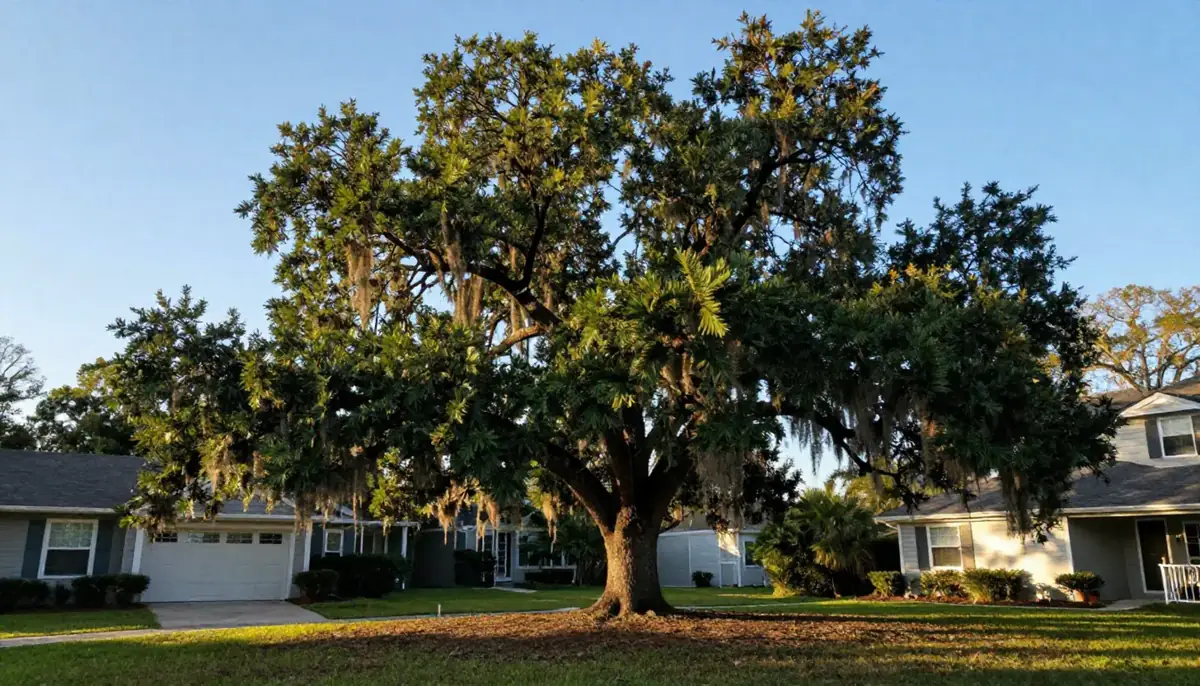
The most common reason a mature tree needs cabling in this county is a codominant stem, two roughly equal-sized trunks or major limbs growing from close to the same point, combined with included bark, where the two grow so tightly together that bark gets trapped between them instead of solid connecting wood. It’s an extremely common structural pattern in mature live oaks and laurel oaks as they reach full size, and it’s largely invisible from the ground unless you know to look for it.
Left alone, that union gets weaker relative to the tree’s growing size and weight, not stronger. Eventually, often during a wind event, sometimes with no obvious trigger at all, one side fails, usually taking a large section of canopy with it. Cabling installed before that happens limits how far the two stems can move apart under load, which meaningfully reduces (though doesn’t eliminate) the chance of a full failure.
What cabling and bracing actually do, and don’t do
A cable is a support line, steel or synthetic, installed high in the canopy between two major stems or limbs, engineered to limit excess movement under wind or weight load. A brace rod is a rigid steel rod installed through a split or a weak union lower on the tree, providing direct mechanical support a flexible cable can’t. Many trees need only a cable; some need a brace rod as well, depending on where the defect is and how advanced it is.
What this system does: extends the safe life of a tree with a real but manageable structural issue, and reduces (not eliminates) the risk of that specific defect failing under load.
What it doesn’t do: reverse the defect, make an otherwise unsound tree safe, or substitute for removal when a defect has progressed too far to manage this way. We assess for that honestly, if a tree’s condition is past what cabling can responsibly support, we’ll say so rather than install hardware that gives a false sense of security. That determination is part of what a tree risk assessment is for.
Start here
Send us a photo of the tree.
You do not have to know whether it needs to come down. That is the part we are for.
- One photo, whole tree in frameTrunk base to top. A close-up of anything that looks wrong helps.
- Text us the photoThe text button below opens the right thread. Add your street and city.
- We come out and lookEvery estimate is in person, free, sometimes the answer is that it needs nothing.
How we actually do it
The arborist identifies the specific union or stem that needs support and determines the right hardware and placement, cable height in the canopy depends on the tree’s structure, not a standard measurement applied to every tree. Installation typically requires climbing or man-lift access into the upper canopy, since a properly placed cable needs to sit at the right point above the defect to actually limit movement effectively. Hardware is installed without unnecessary drilling or damage to the tree beyond what the specific system requires, and we’ll flag when a follow-up inspection should happen, particularly after a significant storm, since wind load is exactly what the system is designed to manage.
Cabling and bracing pair directly with our tree pruning service, reducing wind-catch in a canopy with a known structural issue is often part of the same visit, and with lightning protection, since a lightning-damaged tree can develop the same kind of structural weakness cabling is meant to address.
Frequently Asked Questions
How is cabling different from bracing? A cable is a flexible steel (or synthetic) line installed high in the canopy, connecting two major limbs or stems to limit how far they can move apart under wind load, it’s the more common installation. A brace rod is a rigid steel rod installed lower, through a split or a weak union, to physically hold the two sides together where a cable alone wouldn’t provide enough support. Some trees need one, some need both.
Does cabling fix a structural defect, or just manage it? Manage it, honestly. A cable doesn’t heal included bark or a weak union, it limits movement so the defect is less likely to progress to a full failure, and it buys the tree years of continued, safer growth. It’s not a substitute for removal on a tree whose defect is too severe to manage this way, and we’ll tell you if that’s the situation instead of installing hardware that won’t hold.
Which trees typically need cabling in Pinellas County? Mature live oaks and laurel oaks with codominant stems or included bark at a major union are the most common candidates here, it’s a structural pattern that shows up often as these species reach full size. We assess for it specifically during a tree risk assessment.
Do cables and braces need to be inspected over time? Yes, hardware and the tree’s growth around it should be checked periodically, especially after a significant storm, since cable tension and attachment points can shift as the tree continues to grow and add wood around the installation.
Can cabling help a tree survive hurricane season? It can meaningfully reduce the chance that a specific weak union fails under wind load, which is exactly why it gets installed ahead of storm season on trees with a known structural issue. It doesn’t make an otherwise sound tree "hurricane-proof," and it’s not a substitute for pruning to reduce wind-catch where that’s the more appropriate fix.
Installed throughout Clearwater, Safety Harbor, and the rest of Pinellas County.
Next step
Call (727) 365-1803 or request a free estimate and we’ll assess whether cabling can genuinely extend your tree’s life, or tell you honestly if it can’t.
Google reviews
Rated 4.9 by 464 of your neighbors.
Reviews · Tree Cabling & Bracing
4.9
464 reviews on Google, the count on our public Google listing
“This was the second time I'd hired Happy's to take down some dead trees and I couldn't be happier with the job they did. First off they gave me a great price for the amount of work I needed done.”
“We were looking for a tree service with a certified arborist. We got just what we needed with Happy Tree Service. Steve gave an estimate and knowledgeable advice. They arrived on time did an excellent job and cleaned up all debris. We recommend them and will use them again.”
Every one of these lives on our public Google listing, where we cannot edit or delete a word. Read them all on Google →
Frequently asked
Questions we get asked on this one.
How is cabling different from bracing?
A cable is a flexible steel (or synthetic) line installed high in the canopy, connecting two major limbs or stems to limit how far they can move apart under wind load, it’s the more common installation. A brace rod is a rigid steel rod installed lower, through a split or a weak union, to physically hold the two sides together where a cable alone wouldn’t provide enough support. Some trees need one, some need both.
Does cabling fix a structural defect, or just manage it?
Manage it, honestly. A cable doesn’t heal included bark or a weak union, it limits movement so the defect is less likely to progress to a full failure, and it buys the tree years of continued, safer growth. It’s not a substitute for removal on a tree whose defect is too severe to manage this way, and we’ll tell you if that’s the situation instead of installing hardware that won’t hold.
Which trees typically need cabling in Pinellas County?
Mature live oaks and laurel oaks with codominant stems or included bark at a major union are the most common candidates here, it’s a structural pattern that shows up often as these species reach full size. We assess for it specifically during a tree risk assessment.
Do cables and braces need to be inspected over time?
Yes, hardware and the tree’s growth around it should be checked periodically, especially after a significant storm, since cable tension and attachment points can shift as the tree continues to grow and add wood around the installation.
Can cabling help a tree survive hurricane season?
It can meaningfully reduce the chance that a specific weak union fails under wind load, which is exactly why it gets installed ahead of storm season on trees with a known structural issue. It doesn’t make an otherwise sound tree "hurricane-proof," and it’s not a substitute for pruning to reduce wind-catch where that’s the more appropriate fix.